Will West Virginia Teachers Strike Again
DELBARTON, West.Va. – The coal miner's son had studied his county's rough-and-tumble labor history, written his dissertation on it, taught his high schoolhouse students about it.
At present Eric Starr, who knew history never repeats itself, felt history doing only that. And he was part of it.
Continuing at a secret meeting like those held by hitting miners a century ago, dressed in black except for a ruddy bandana similar the ones those miners wore, he exhorted his fellow public school teachers to defy the governor and their own unions and stay out on strike.
"I'grand not going back,'' he said. "We've been sold out!''
That was last wintertime. Mingo County teachers – with no legal right to strike, no encouragement from their wedlock and little prospect of victory – became the first in West Virginia to vote to walk out over their health plan and their pay.
The 1-mean solar day walkout spread.
On Feb. 22, 2018, teachers beyond West Virginia went on strike, sparking a movement that spread to other ruby-red states, including Oklahoma and Arizona, and then, this year, to Los Angeles and Denver. On Thursday, teachers programme to strike in Oakland, California.
Just the 2018 West Virginia instructor strike, which inverse and then much nationally, didn't change that much back where it started. And on Tuesday, Due west Virginia teachers again staged a walkout – simply to maintain the status quo.
Starr sees the irony.
"I honey seeing what'south going on elsewhere,'' he says. He's 28, in his fourth year of teaching. "But West Virginia tin be a slow place to modify.''
When the 2018 Westward Virginia strike ended March seven, it seemed similar a great victory for public school teachers, who for years had been blamed widely for the failures of American schools, and for West Virginia schools in item.
Simply history, even when it repeats itself, isn't that simple. The 2018 strike's legacy is still in doubt.
- The state's promise of a dedicated funding source for public employees' health insurance – the master issue in the strike – remains unfulfilled.
- Despite a 5 pct raise, teacher pay remains far backside neighboring states', a disparity that explains why the yr began with 700 classroom vacancies, or four percent of the state instructor strength.
- The settlement did not increment the number of school specialists, like counselors and nurses, to help students from families scarred past the state'south opioid epidemic.
- The teachers' vow during the strike to "recollect in November'' produced but mixed results. Republicans, most of whom opposed instructor demands, kept control of both houses in the Legislature. This yr they revived proposals that helped prompt the 2018 strike. Teachers and service personnel went on strike once more.
The walkout on Tuesday closed schools in nearly every Due west Virginia canton, and lawmakers sidelined the education legislation teachers were protesting. That's a victory for teachers.
But, teachers say, they are yet waiting for the kinds of policies that would evidence them respect. Suspicious of the state'due south GOP leaders, teachers are striking again Wed, to ensure lawmakers don't revive the bill in question. Nearly all schools are closed.
Teachers in America:No matter where they work, they experience disrespect

'Any talks of striking'?
If last year's strike wasn't revolutionary, it was remarkable.
At a time when organized labor seems in terminal refuse, a national public school teachers' move emerged from the coalfields of southern Due west Virginia, i of the most isolated and conservative corners of America.
At a fourth dimension when political partisanship is peaking – and despite the Democratic camber of teachers' unions – the strike united Clinton and Trump voters. Information technology was a political unicorn: a "liberal" cause advocated past conservatives.
But information technology was no anomaly. Children here are raised on stories of battles between miners and mine companies in what came to be known as "Bloody Mingo.'' Many of the teachers who walked out were first on picket lines when they were in diapers.
Yet these old passions might non have been revived without a weapon the miners never enjoyed – social media.
On Jan. half dozen, 2018, a teacher posted an innocent query on a Facebook folio: "Just curious if there are whatsoever talks of hit.''
Soon, at that place was talk of little else.
Poll:Even when teachers strike, Americans requite them high grades. Unions fare worse.
Welcome to the Mountain Country
Jay O'Neal is a eye schoolhouse social studies teacher who moved to West Virginia in 2015. After his showtime year, he realized that considering of increasing health insurance costs, he'd have habitation $450 less than the previous year.
Teachers beyond the nation lost ground economically during and after the Great Recession, as states slashed didactics spending. West Virginia, whose signature coal industry has complanate, ranked 48th in instructor pay earlier the strike, according to the National Pedagogy Association.
Withal teaching in Due west Virginia has gotten harder equally students have gotten needier, partly because of the opioid crisis. Many are in a household with neither biological parent, and teachers sometimes must find ways to keep kids fed over the weekend, or get their electricity turned back on. Ane of O'Neal's students found his father with a needle sticking out of his arm, dead of an overdose.

O'Neal wasn't born into West Virginia'due south "strike civilization.'' But in October 2017 he started a Facebook group page to unite members of the country's two chief teacher unions, the W Virginia Education Association and the rival West Virginia Federation of Teachers.
His timing was propitious. The country'south public employee health insurance agency had announced a new round of cost-saving measures. One based premiums for family coverage on the household'south total income, rather than but the teacher's. Another was a health plan that would effectively penalize those who didn't practise things similar provide personal biometric data, get to the gym or habiliment an activity tracker like a Fitbit.
The program was anathema to famously independent-minded Westward Virginians. What business is it of some edible bean-counter what my spouse makes? Or what I weigh?
O'Neal heard plenty of grumbling in the teachers' lounge, but piddling or zero in public or on Facebook. His teachers' folio had merely about ane,000 members. "I don't get information technology,'' he told a friend. "Goose egg'south happening.''
It was every bit if "strike" was a dirty word. "Everyone was thinking about it,'' recalls Eric Starr. "Then someone worked upwards the guts to say it.''
Strike fever
That someone was Rachel Kittle, a 32-year-one-time special educational activity instructor from – no surprise – the coalfields. She didn't feel gutsy, however. Hitting was just what she and her colleagues were already talking almost.
Soon after her Jan. half dozen post – "any talks of striking?'' – O'Neal got a message from a friend: "Accept y'all looked at Facebook?''
TEACHERS' VICTORY: Showed 'power of women'
At that place was Kittle'southward query, followed by an explosion of comments. The showtime was dismissive: "The unions are terrified and the teachers are unwilling.'' Only there were other voices:
- "Not all teachers.''
- "At that place volition non be an end to the cuts until a line is drawn.''
- "As long every bit you accept it without protesting, they will go along giving it to you.''
- "Teachers went on strike in 1990. How did that go organized?''
Soon, O'Neal couldn't keep up with requests to join the group.
Strike fever spiked later on Gov. Jim Justice, who'd been elected as a Democrat with marriage support earlier becoming a Republican to back Trump, proposed a mere 1 per centum heighten in his Country of the State address.
Dale Lee, president of the WVEA union, felt compelled to address the topic at a rally on Martin Luther King Jr. Day. Teachers expecting a call to the barricades were disappointed.
"I've heard a lot of people talk about, "It's time for a walkout; it's time for a strike,' " Lee said. "It'southward not the beginning step in what we should exercise to reach our goals.''
But this was a battle in which union leaders would be followers.
It started in the coalfields
On January. 23, Mingo County teachers became the starting time in the country to decide to skip school for a day to become to the state capital letter to protestation. They called it "Fed Up Fri.'' Several other southern coalfield counties chop-chop followed suit.
Without a right to strike or bargain collectively, the teacher unions had become more practiced at lobbying the state officials who set their members' bounty than at against them. Now, they struggled to take hold of up with the rank and file. A WVFT official told the Charleston Gazette-Postal service that the matrimony didn't know how many counties had decided to walk out, but was sending staffers to county meetings "to detect out what'southward going on.''
On Fed Up Fri, teachers from the coalfields gathered in the capitol rotunda in Charleston to protest. As they chanted, colleagues around the state watched.
A month after, on Feb. 22, after some other one-day walkout and a statewide strike authority vote, 20,000 teachers went out.
Timeline:How the 2018 West Virginia teacher strike evolved
School was airtight in all 55 counties. Superintendents, already facing a instructor shortage, didn't have nearly enough subs to hold classes. The teachers would never lose a twenty-four hours'south pay.
Public opinion seemed with the teachers. When the attorney general said the strike was illegal and offered to become to courtroom on behalf of county schoolhouse boards, he got no takers.
5 days into the strike, the governor and the union leaders, who'd been negotiating, appear a settlement, including a 5 percent raise. They told teachers to go back to work two days later, on March 1.
Simply the Senate'due south Republican leaders had not signed off; the rank and file had non been consulted; and the governor, some teachers pointed out, was a coal-company owner. "We weren't gonna fall for his word,'' Kittle recalls. Teachers outside the capitol chanted: "Dorsum to the table!'' and "Nosotros got sold out!''
At county meetings like the one in Mingo where Eric Starr spoke up, the rank and file agreed. They weren't going back – they were going mutiny.
The strikes spread
Meanwhile, in Arizona, a teacher named Noah Karvelis had started a Facebook page like the i in W Virginia. Near of his colleagues supported a strike in their country, he tweeted, "especially with … WV'southward success.''
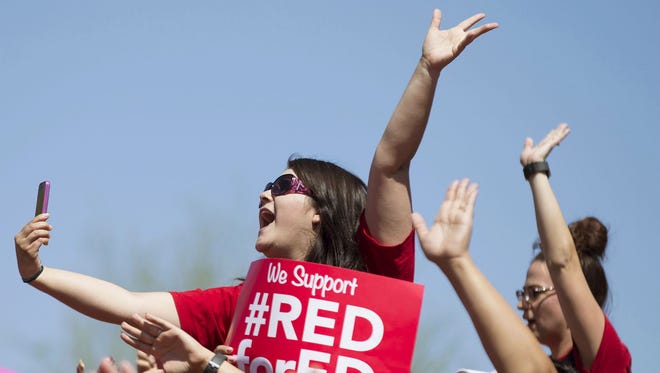
He created a Facebook event that called on Arizona teachers to wear ruby: "Westward Virginia is showing the entire nation what happens when teachers stand in solidarity.''
Finally, West Virginia's Republican Senate agreed to a 5 percent raise for all state employees. And the governor promised to freeze wellness insurance premiums for 18 months; to create a task force to observe a dedicated source of health insurance funding; and to waive higher costs for workers who didn't comply with the wellness plan.
On March 7, after nine canceled school days, the teachers went back to class.
But teachers in other states started to walk out. On April 2, Oklahoma and some counties in Kentucky; April 26, Arizona; Apr 27, Colorado. On May xvi, North Carolina teachers staged a i-twenty-four hours walkout and rally.
A glass half empty?
A year later on, it'due south easy to emphasize what the West Virginia teacher strike didn't do.
The raise, which averaged about $2,000 per instructor, was hardly life-changing. It let teachers pay off some bills or pay downward some loans, or maybe buy a car. But their colleagues keep to flee to college-paying districts in other states. Mingo High Schoolhouse, for instance, has been trying since May to replace its choir director, who left for a similar chore in Ohio that paid $10,000 more. No one has even applied for the vacancy.
Equally for health insurance, the governor has proposed $150 million in the state budget to stabilize employees' costs. Just there still has been no understanding on how to insulate such funding from the yearly budget process.
The strike'due south political legacy is also unclear. Some fault teachers for not mobilizing enough relatives and friends to vote; some say teachers themselves didn't plow out in enough numbers, reviving memories of the pre-strike complacency that frustrated activists like O'Neal.
Whatsoever its cause, the teachers' failure in November to elect more supporters in the Legislature came back to haunt them this year.
The broad education bill that prompted Tuesday'south walkout would have given teachers some other 5 percentage enhance, but also allowed the country to constitute its showtime charter schools. It would have allow parents take taxpayer coin for their child'south education in public school and spend it on options such as private school. Those were the sorts of problems behind the 2018 strike.
To kill legislation that hadn't fifty-fifty been passed, teachers had to strike again. They won a victory in ensuring their state of affairs didn't get worse. Merely it also didn't get better.
The old-time miners went on strike against mine owners. Today, public teachers ultimately strike against taxpayers, personal or commercial. Taxpayers are voters, and voters say they're for higher teacher salaries. They also say they're against higher taxes.
Talk of the nation
In ane fashion, the strike didn't so much revive history as reverse information technology.
With the fall of coal, a region once famed for sometimes-cussed independence became synonymous instead with a fatalistic credence of the condition quo and a dependence on welfare, from food stamps to disability pay.
The strike, however, put West Virginia suddenly in the vanguard of the middle working class.
No one personifies that reversal more Robin Ellis, a Mingo High English instructor who is also a grandmother, a social conservative, a Republican and 1 of the 69 percent of West Virginians (and 83 percent of Mingo residents) who voted for Donald Trump over Hillary Clinton in 2016.
She's also the daughter of an 83-year-onetime retired marriage miner who went on strike several times.
During last year's strike, Ellis stood on her town's chief street to flag down motorists and, equally traffic backed up, make the teachers' instance. And, like immature Eric Starr, she rose at a meeting after the tentative settlement to urge her colleagues to stay out.
She says the strike was almost more than money or respect. It was about an obligation to the generations by. "The word 'strike' prompts something in us here,'' she says.
"I don't think my daddy has ever been prouder of me.''
Source: https://www.usatoday.com/story/news/education/2019/02/20/teacher-strike-west-virginia-school-closings-education-bill/2848476002/
0 Response to "Will West Virginia Teachers Strike Again"
Post a Comment